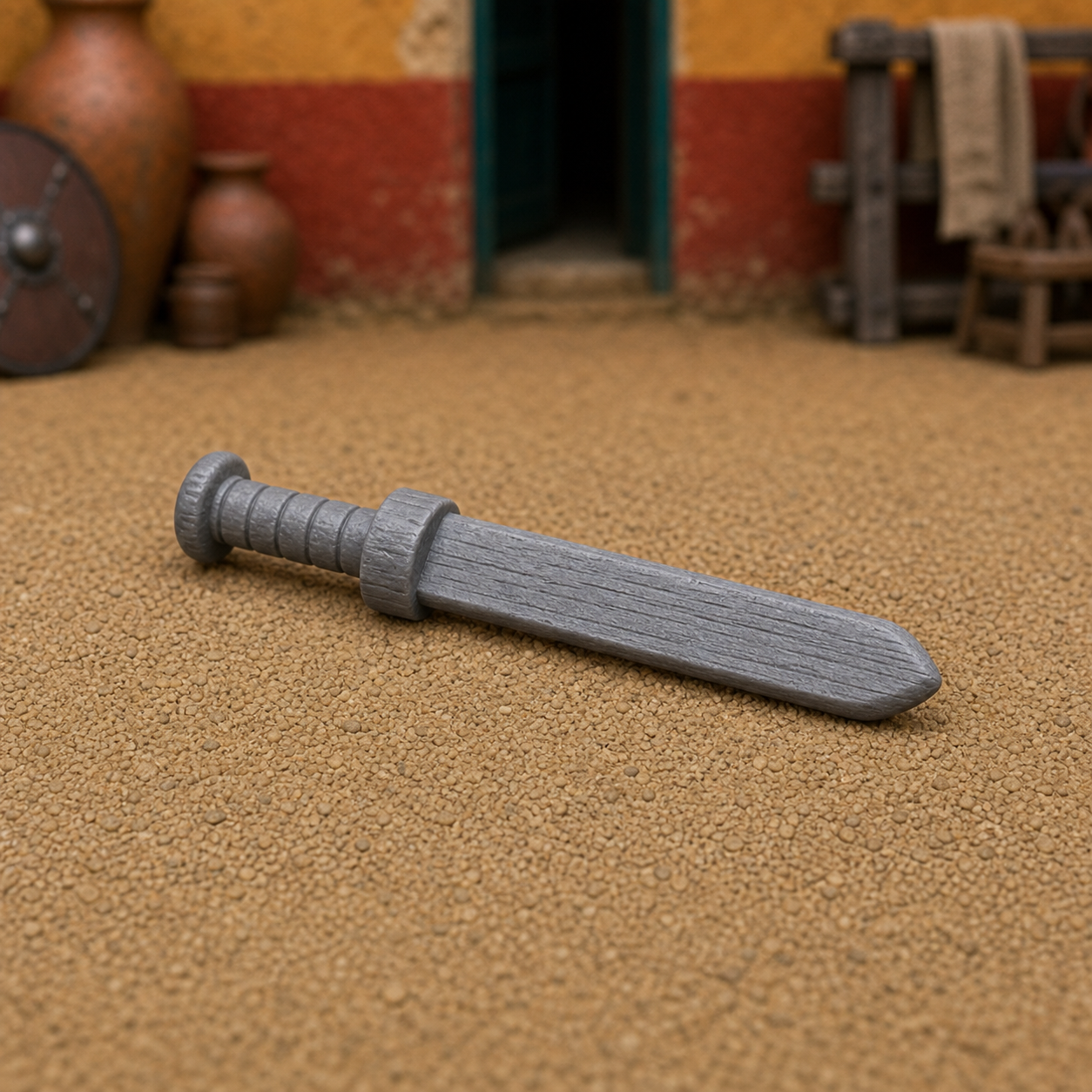

The gladius ligneus - "wooden gladius" - was the standard practice sword of every Roman gladiator school and legionary training camp. Cut from oak or ash to roughly the length of a real gladius (about 60 cm) but built deliberately heavier, it was used by recruits to drill thrust angles and arm strength against the palus and against weighted training shields. Vegetius, writing around the 4th century CE in De Re Militari, records that legionary recruits trained with weapons doubled in weight - and the gladiatorial schools followed the same principle.
This single-prop miniature depicts a typical worn practice sword: chipped oak grain, a leather-wrapped grip, and a faintly battered point from thousands of strikes against the post. Recovered parallels include wooden sword fragments from Roman legionary camps along the Rhine and Danube limes (1st-3rd c. CE). Drops directly into ludus or castra dioramas as a small detail prop - on a rack, on a bench, or fallen on the sand. Period: Roman antiquity, 1st c. BCE - 4th c. CE.
Painting tips
- Wooden body: pale tan oak base, brown wash, dry-brush highlights on raised grain.
- Leather grip: dark brown base, edge highlight in tan.
- Optional weathering: light grey-tan dry-brush along the point and edges to show palus wear.
Historical sources & further reading
- Vegetius, De Re Militari, Book I, ch. 11 (c. 4th century CE)
- Junkelmann, Marcus. Familia Gladiatoria (1996)
- Goldsworthy, Adrian. The Complete Roman Army (2003)
⚠ Small parts. Not suitable for children under 14.