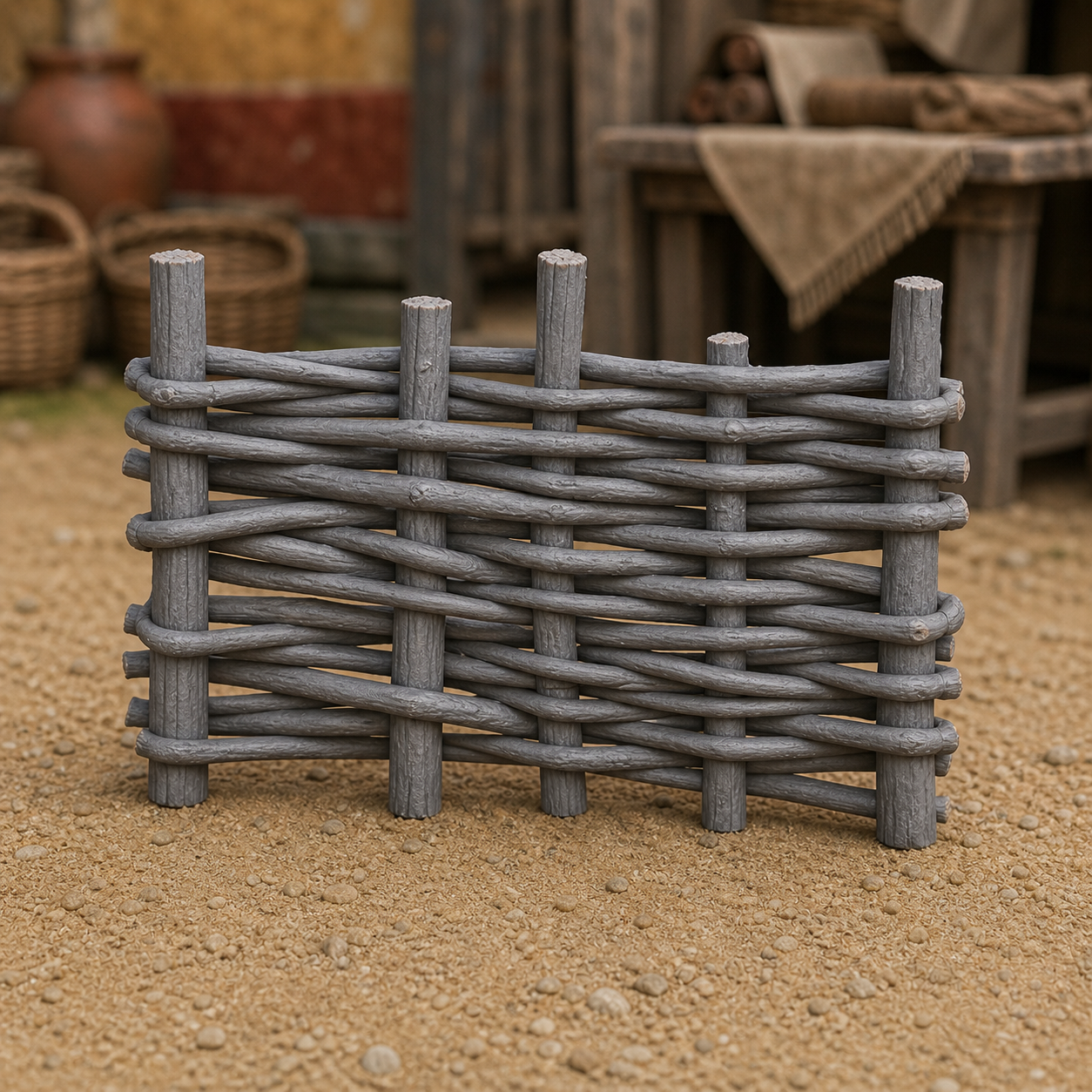

A short run of woven hazel fence - the everyday boundary marker of an early medieval Parisian market. Period: Early Middle Ages, c. 500-1000 CE.
Paris in the Merovingian and early Carolingian period was a town of timber, wattle and thatch built around the Île de la Cité and the wooden bridges to the south bank. Markets, garden plots and animal pens were divided by sections of wattle fencing: split hazel or willow rods woven through driven stakes (palus). Fences were repaired daily as branches dried and snapped. This piece is sculpted as a single fused section with two thick end-stakes and a tight chunky weave - readable as a market pen edge, garden line or temporary stall division.
Painting tips
- Hazel rods: warm tan with a sepia wash in the weave.
- Stakes: slightly darker brown, dirtier at the base.
- Optional: drybrush the ground-line ochre for splash and dust.
Historical sources & further reading
- Carolingian capitulary regulations on market fencing
- Vince, Saxon London (early medieval wattle techniques)
⚠ Small parts. Not suitable for children under 14.