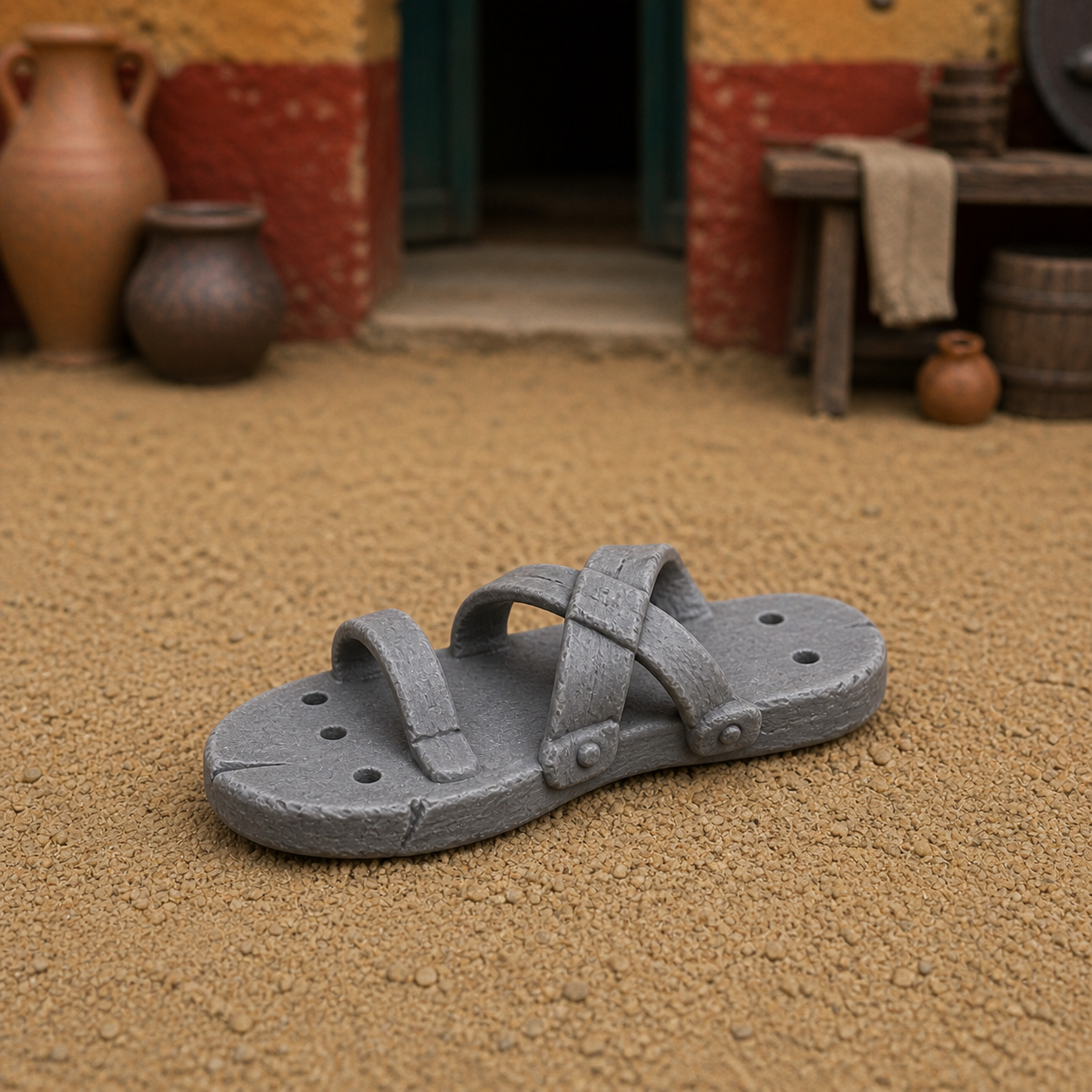
Roman sandals - including the military caligae, the household soleae, and the simpler workshop sandals - were built from layered cowhide soles, leather upper straps, and iron hobnails (in the military versions). Daily wear, especially in a working ludus or marching legion, broke down sole layers and snapped straps fast. The sutor caligarius - sandal-maker and -repairer - was a common occupation across Roman cities and military camps.
This single-prop miniature captures a sandal mid-repair: top sole layer being replaced, a row of fresh hobnails laid out alongside, an awl and a strip of new leather visible. Recovered parallels include intact caligae and household sandals from Vindolanda, Saalburg, and Pompeii. Period: Roman antiquity, 1st c. BCE - 4th c. CE.
Painting tips
- Sole layers: alternate brown tones to suggest old worn leather and fresh replacement.
- Iron hobnails: cool iron-grey, polished steel highlight.
- Top straps: rich dark brown leather, tan edge highlight.
- Workbench underneath: pale tan oak, brown wash.
Historical sources & further reading
- Vindolanda Trust: shoe and caligae finds
- Junkelmann, Marcus. Reconstructing the Roman Gladiator (2000)
- Goldsworthy, Adrian. The Complete Roman Army (2003)
⚠ Small parts. Not suitable for children under 14.