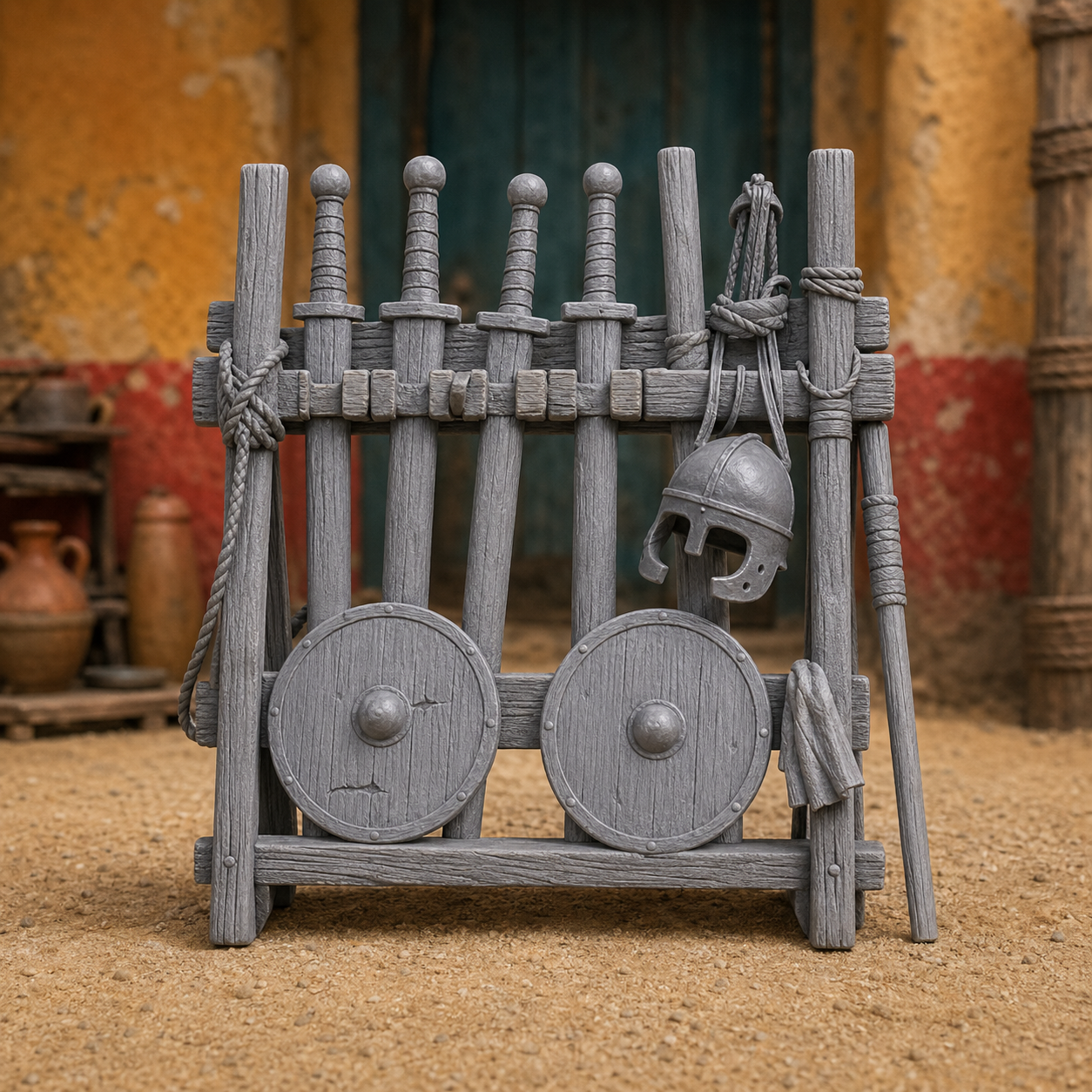
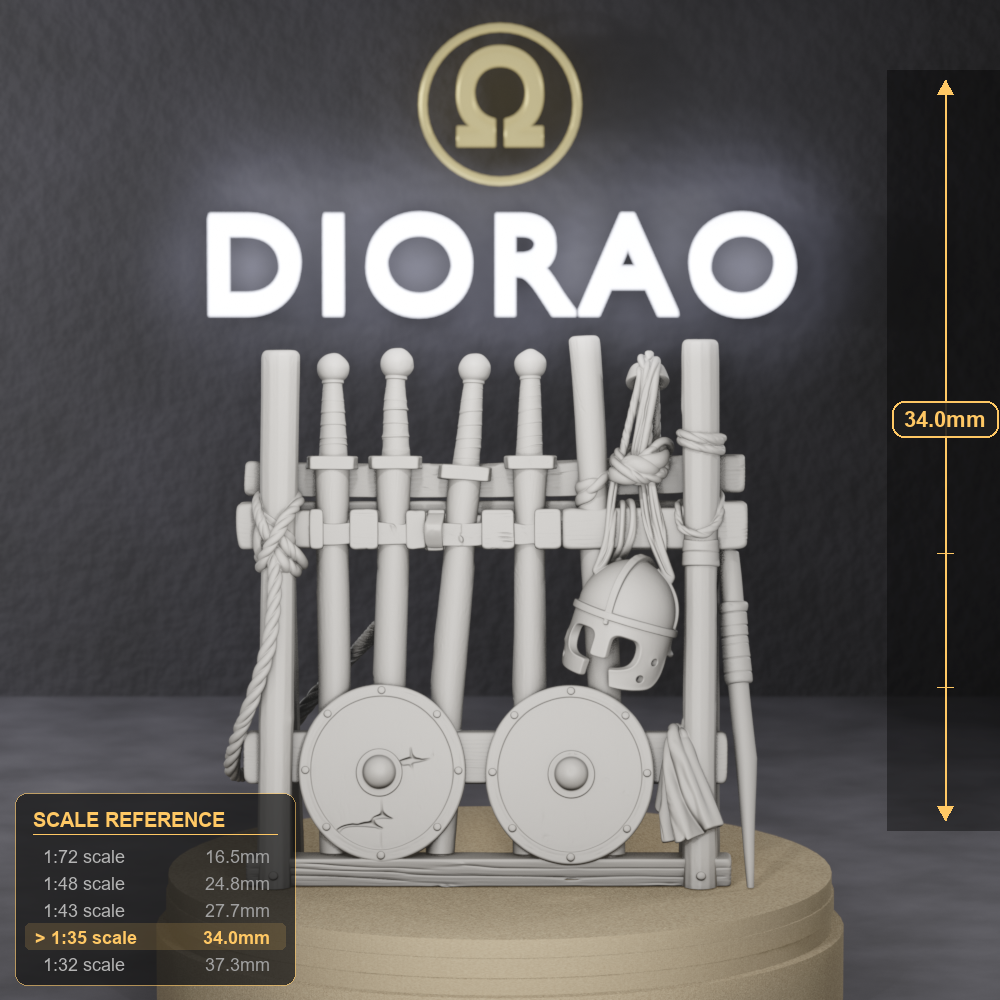
The armarium - weapon rack - was the central storage for a Roman gladiator school's training arsenal: rows of wooden practice swords (gladii lignei), oversized training shields (scuta), helmets in various fighting styles (murmillo, thraex, secutor), and the leather straps and belts that went with each kit. A well-equipped ludus typically ran several racks - one per fighting style - managed by the armiger, the gladiator school's quartermaster, who kept inventory of every blade, shield, and helmet in the building.
This piece depicts a busy training rack mid-day: practice swords in their slots, a couple of helmets hung on pegs, a stack of training shields leaning against the side, and assorted leather straps and belts hanging from the upper bar. Surface detail captures the wear of a working ludus - chipped paint on helmet rims, scuffed shield faces, a splinter or two on the wooden frame. Excavated parallels exist from the Ludus Magnus in Rome (1937-1968 excavations) and barracks fittings at Pompeii's gladiator barracks. Period: Roman antiquity, 1st c. BCE - 3rd c. CE.
Painting tips
- Wooden frame: medium oak base, dark wash, edge-highlight pale wood on stress points.
- Practice swords: pale tan wood for the blades, darker handles, brown wash.
- Helmets: bronze or iron base depending on style, brown ink wash, polished highlights on rim and crest.
- Shields: dark wood-brown core with painted rim - historically gladiator shields had bold red, white, or black geometric designs.
- Leather straps: rich brown with tan edge highlight.
Historical sources & further reading
- Excavations at the Ludus Magnus, Rome (1937-1968)
- Pompeii excavations: gladiator barracks at Regio V Insula 5
- Junkelmann, Marcus. Familia Gladiatoria (1996)
- Köhne, Ewigleben & Jackson. Gladiators and Caesars (2000)
⚠ Small parts. Not suitable for children under 14.