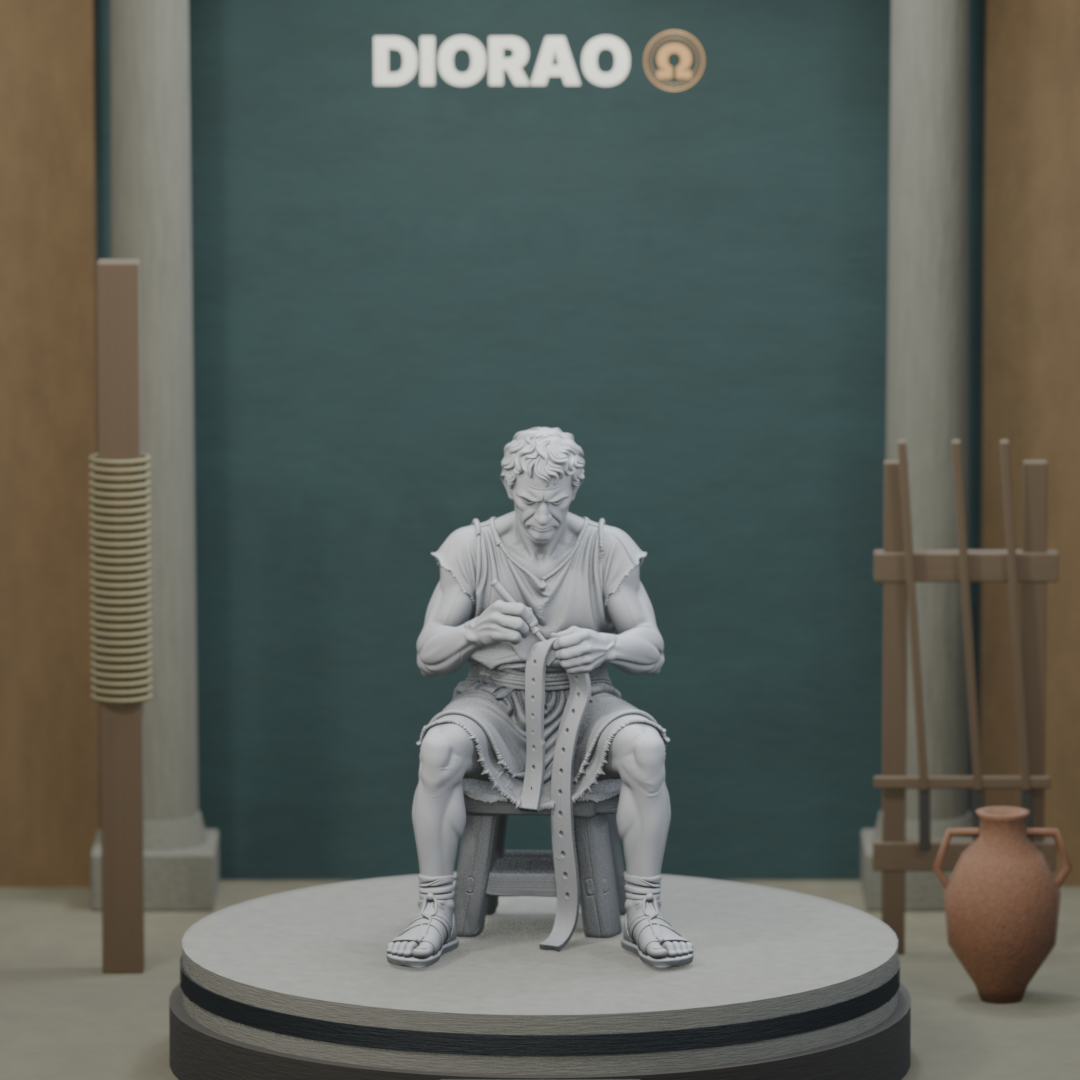
The leather-repair craftsman - known by the general Latin term sutor, or more specifically sutor caligarius when working on footwear - was an essential support role inside every Roman gladiator school. Roman ludi were industrial-scale operations: a single major school in Rome or Capua might house 100 to 300 gladiators, all of whom burned through training gear at a relentless pace. Helmet liners, manica arm-wraps, balteus sword-belts, subligaculum waist-cloths, sandal soles, and shield grip leather all wore through within weeks of constant palus drills. A small staff of leather workers - usually slaves, freedmen, or contracted civilians - kept the school serviceable from low benches in the shaded edges of the courtyard.
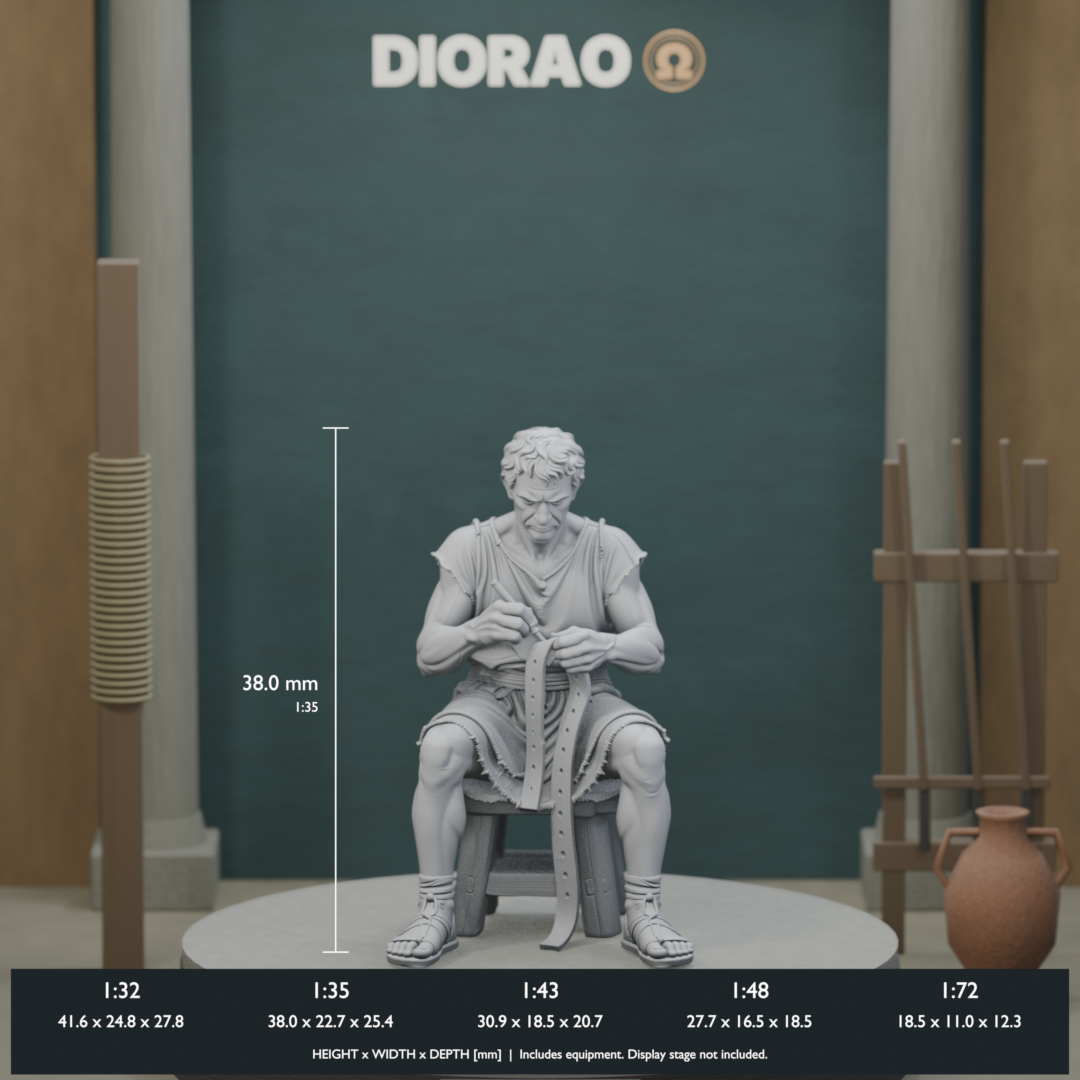
This miniature depicts a typical sutor at his workstation: seated on a low stool, bent forward, working a curved knife (lunellum) along a strip of cured cowhide. His tools - awl, bone folder, beeswax block for waterproofing, iron buckles for new straps - sit in a small wooden box at his feet. Roman leather-craft was sophisticated: archaeologists have recovered intact gladiator straps and shoes from Pompeii (79 CE), Vindolanda (1st-3rd century CE), and the Roman fort at Saalburg, demonstrating multi-layer construction with copper rivets, bronze buckles, and decorative tooling. The bench, posture, and tool layout shown here match those excavated examples. Period: Roman antiquity, 1st century BCE - 3rd century CE.
Painting tips
- Apron: rich brown leather base, dark wash, edge-highlight in tan.
- Tunic: off-white linen, sepia wash, optional ochre stripes (clavi) for status detail.
- Skin: warm Mediterranean tones - terracotta base, flesh highlights.
- Leather strips on bench: vary base browns to suggest different hides.
- Tools: iron-grey for blade, bone-yellow for awl handle.
Historical sources & further reading
- Pompeii excavations: gladiator barracks at Regio V, Insula 5 (1900-present)
- Vindolanda Trust: leather and shoe finds from the 1st-3rd century CE fort
- Junkelmann, Marcus. Reconstructing the Roman Gladiator (2000)
- Goldsworthy, Adrian. The Roman Army at War (1996)
- Corpus Inscriptionum Latinarum (CIL) VI - sutor inscriptions
⚠ Small parts. Not suitable for children under 14.