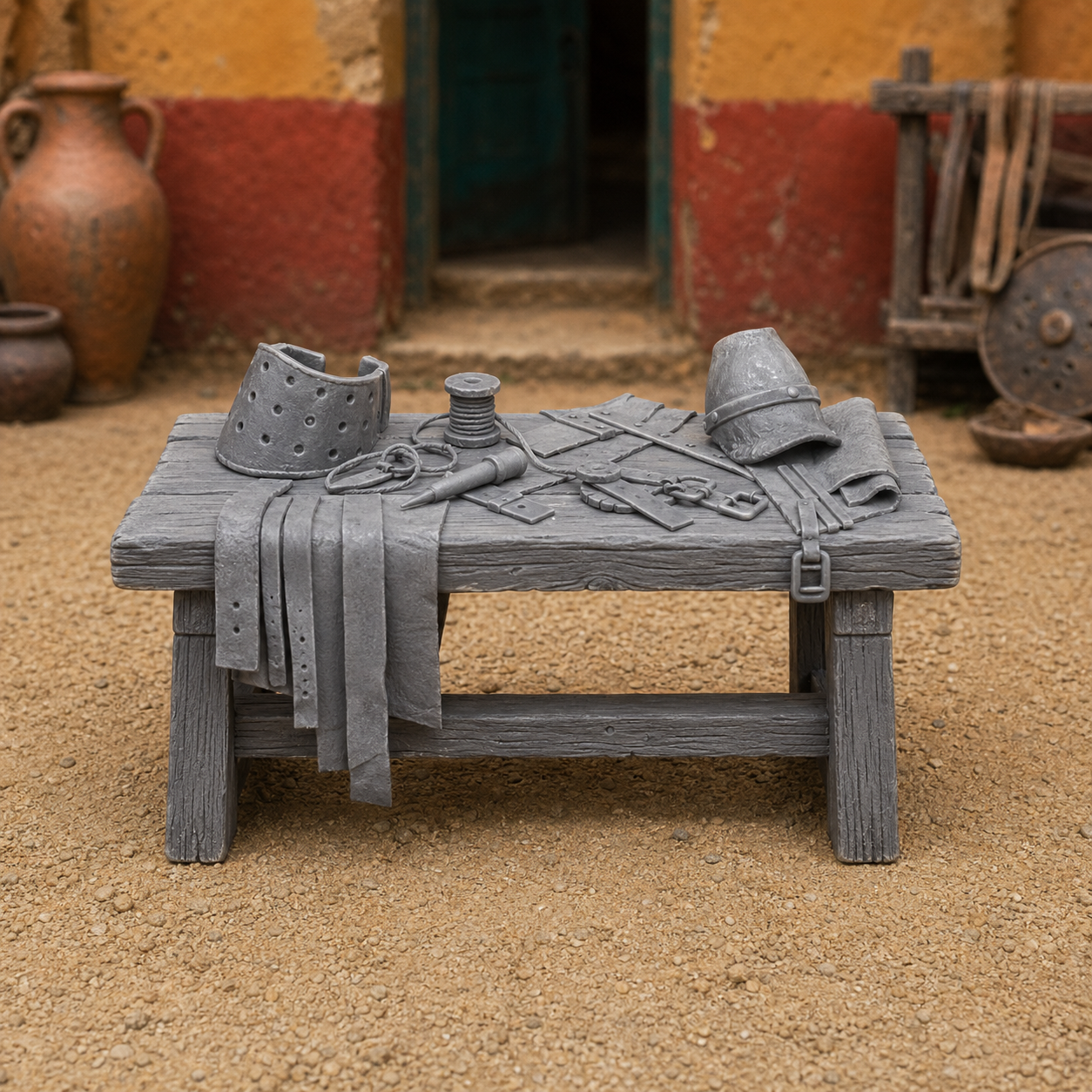
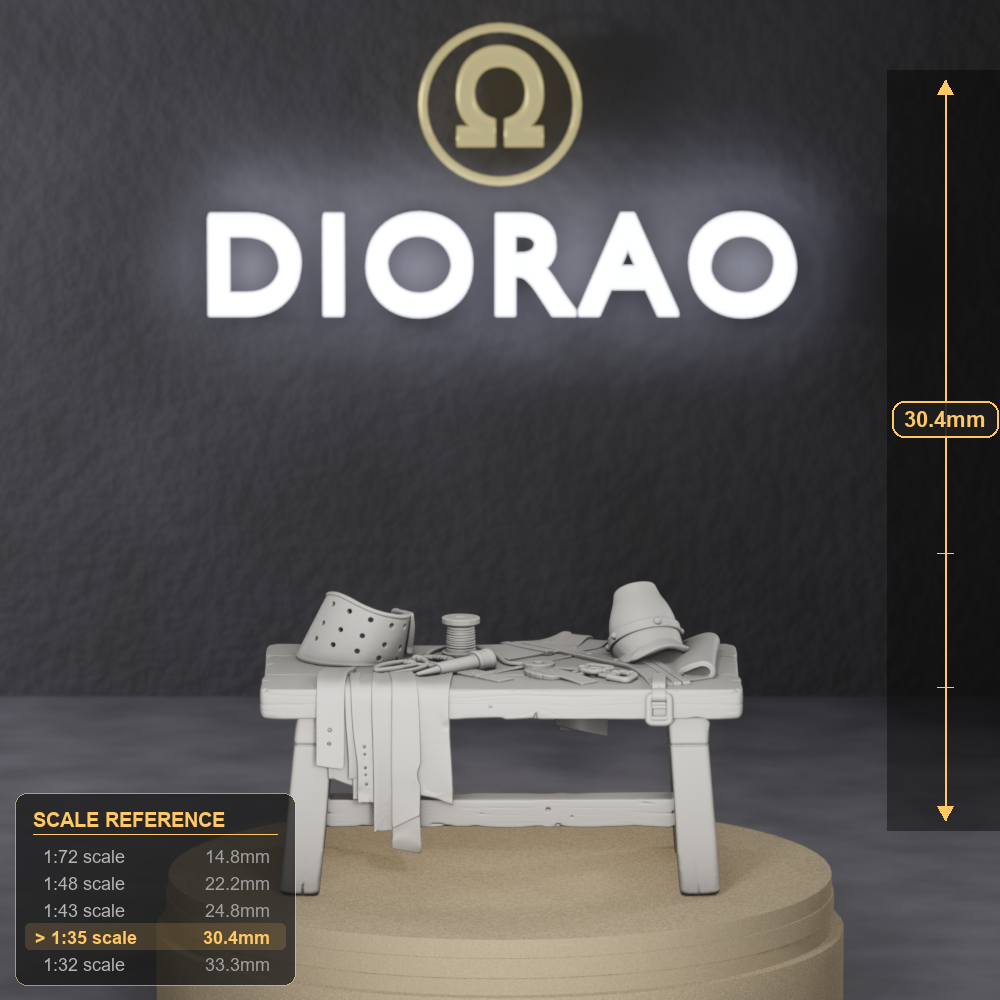
The leatherworker's bench (Latin scamnum or mensa sutoria) was a fixed feature of every Roman gladiator school's working courtyard. Built low, narrow, and waist-high to a seated craftsman, the bench functioned as both work surface and tool storage: cured hides were stretched across its top, tools (lunellum curved knife, awl, bone folder) were laid along its edge, and small iron buckles, copper rivets, and beeswax blocks rested in shallow trays at the back. Roman ludi operated at industrial scale and ran constant gear maintenance - every helmet liner, sword belt, and sandal sole eventually came back to a bench like this.
This miniature depicts a typical sutor's bench in mid-work: a leather strap clamped along the top, a curved lunellum resting on the surface, an awl and bone folder beside it, and a pile of cut leather strips and a roll of unworked hide along one end. Excavated parallels come from Pompeii's gladiator barracks (Regio V, Insula 5) and the Vindolanda fort, where intact leather stock and tool layouts have been preserved. The bench is designed to pair with the DIORAO Leather Repair Worker (DIO-002), but works as a standalone craftsman prop in any Roman diorama.
Painting tips
- Bench wood: medium oak base, dark wash, dry-brush along edges and stress points.
- Leather strips: vary the base browns to suggest different hides - some richer, some pale.
- Hide roll: pale tan with subtle ochre wash.
- Tool blade (lunellum): cool iron-grey, gloss varnish for working edge.
- Buckles: brass or dark iron, picked out individually.
Historical sources & further reading
- Pompeii excavations: gladiator barracks at Regio V Insula 5
- Vindolanda Trust: leather and shoe finds
- Junkelmann, Marcus. Reconstructing the Roman Gladiator (2000)
⚠ Small parts. Not suitable for children under 14.